AIEGNOS
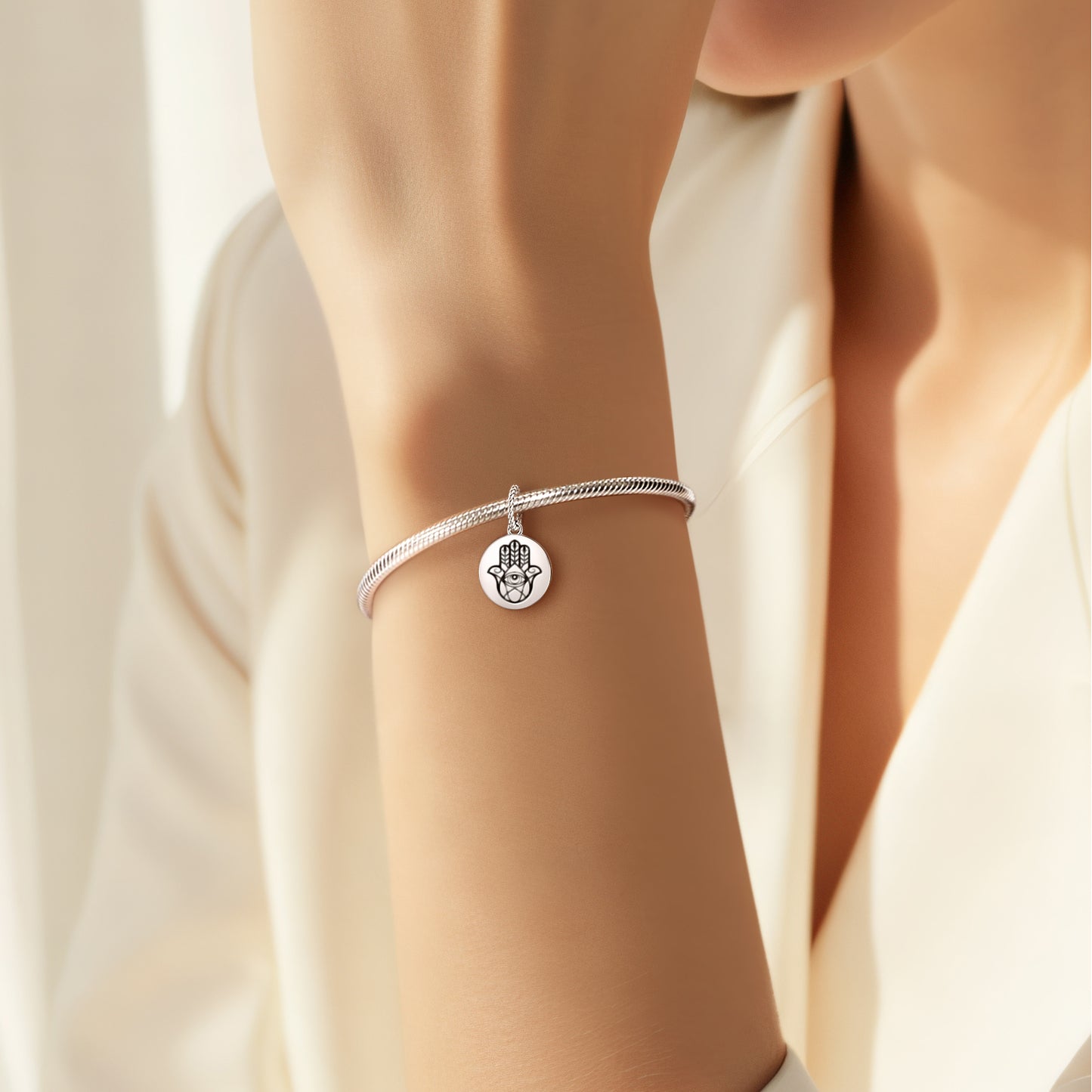
Hamsa Pendant Dangle Charm
Hamsa Pendant Dangle Charm
BUY 2 GET 2 FREE SITEWIDE
BUY 2 GET 2 FREE SITEWIDE
Couldn't load pickup availability
The Hamsa is a hand-shaped amulet widely popular in the Middle East and North Africa, particularly significant in Islamic and Jewish beliefs. It is usually depicted as a palm-shaped pattern with fingers spread upward or downward, sometimes with an eye symbol in the center, representing protection against evil and bringing good luck.
The origin of the Hamsa can be traced back to the Phoenician civilization from 1550 BCE to 330 BCE, when the Phoenicians used palm images to represent their guardian goddess Tanit, who controlled the lunar cycle. Over time, this symbol gradually evolved into a self-protective amulet to ward off the 'evil eye.' In Judaism, the Hamsa is called the 'Hand of Miriam,' associated with the sister of Moses and Aaron in the Bible, and related to the fifth letter 'het' in the Hebrew alphabet, which represents one of God's holy names. In Islamic culture, the Hamsa is called the 'Hand of Fatima,' honoring Fatima Zahra, the daughter of Muhammad, whose five fingers symbolize the Five Pillars of Islam.
The Hamsa is not only a religious symbol but also a symbol of peace and hope in the modern world. Many Jews and Arabs wear the Hamsa to demonstrate their shared faith foundation and common roots. Additionally, the Hamsa is often used in jewelry, wall hangings, keychains, and other decorative items, becoming a popular design element.
In summary, as an ancient and mysterious symbol, the Hamsa not only holds important religious significance but also plays a role in protection and blessing in modern society.
Share